There is a widespread idea about Latin American Spanish: that it was cast in the first decades of the sixteenth century, in the Caribbean, and has carried that birthmark ever since. It is a tidy idea, and a convenient one. The trouble is that the population figures do not support it, and that half a dozen linguistic changes happened on both sides of the Atlantic at the same time, long after that supposed founding.
What the argument is actually about
Many Latin American varieties share features with Andalusian and Canarian Spanish that distinguish them from north-central Castilian. Hence the Andalusian theories: Andalusian Spanish would have been the decisive model while American Spanish was forming. Against them stand those who question the demographic data behind the claim. The argument has run for a century, and has produced almost everything we know about how Spanish reached the continent.
Where the suspicion comes from
The year emigrants spent in Seville waiting for a ship
Several features that are widespread in Latin American Spanish (seseo, much of its yeísmo, and ustedes instead of vosotros) coincide with major features of Andalusian. Add the commercial dominance of Seville throughout the colonial enterprise and the suspicion writes itself. Bringing the Canary Islands into the equation, Diego Catalán coined a label in the late 1950s that has stuck: Atlantic Spanish.
One argument in its favour is especially vivid. Before boarding, many emigrants spent long periods in Seville or Cádiz waiting for passage, living among sailors and dockers, and then another month or two at sea. That was ample time to become familiar with the vocabulary of the ship.
This would help to explain something still alive today: words that in Spain are purely nautical and in Latin America belong to daily life. Botar, amarrar, atracar, balde, abarrotes, timón. Part of this everyday vocabulary travelled through the ports.
Then there is the famous archaic streak of American Spanish against the modern peninsular kind: lindo, cobija for «blanket», platicar for «to talk», pollera for «skirt». It is put down to the relative isolation of many regions during the colonial period, and to the tendency of peripheral dialects to keep what the metropolis has already discarded.
A century of argument
Wagner, Henríquez Ureña, and a dispute settled by counting passengers
In 1920 Wagner was among the first to propose an Andalusian origin for American Spanish; seven years later he narrowed it to the lowlands and coasts. Henríquez Ureña answered him, and from then on the argument stopped being a matter of intuition and became a matter of archives.
Henríquez Ureña starts counting
He worked out the origins of some ten thousand early settlers from documents compiled by Icaza, and concluded that Andalusians were only a third. The objection came later: ten thousand is few against the total, and the first decades need not represent the whole formative period.
Boyd-Bowman multiplies the sample by four
Between the 1950s and 1970s he identified the regional origin of forty thousand settlers, twenty per cent of the first century’s total. His results are often cited as decisive proof of Andalusian origin. They are less decisive than that.
What the figures really say
Before 1519, around 30 % of settlers came from Seville and Huelva, the largest contribution from any single region. But the sum of those of Castilian origin is nearly as large, and adding Extremadurans and Leonese pushes it past the Andalusians. Later in the period, northern emigration steadily grows.
And there is a glaring bias
Many prospective settlers waiting for passage in Andalusian ports gave Seville, Huelva or Cádiz as their place of residence although they had been born and raised elsewhere. An unknown number of people from other regions entered the statistics as Andalusians.
The awkward question
Even with the complete census, there would be no answer
Suppose a full demographic profile of the colonial period could be assembled. One question would remain that no figure answers: how much is enough?
Nothing suggests a simple correlation between the share of the population a region supplies and the transfer of its linguistic features. Whether Andalusians were 30 %, 20 % or even 10 % of a colonial population does not rule out a decisive influence, especially if the rest were split among many regional dialects, each with a smaller share.
And the reverse holds too: a numerical majority of Andalusians in a region does not automatically make that region’s dialect Andalusian. The sociolinguistic weight of a group is not measured in heads.
The equation that fails
The highlands do not speak Castilian. They speak what levelling left behind
It is tempting to sum it up as coasts equal Andalusia, inland capitals equal Castile. But it is inaccurate. In the inland cities, contact with Castile was never as intense as coastal contact with Andalusia, and administrative staff were never a dominant share of the population. The proof is in what is missing: the colonial capitals have no interdental z, no uvular j, no vosotros, no apical s. What happened in the highlands was not the arrival of one regional influence but the absence of any. Out of that came «default» patterns, the product of levelling among settlers from everywhere.
The figures that change everything
A single fleet could bring almost half a town
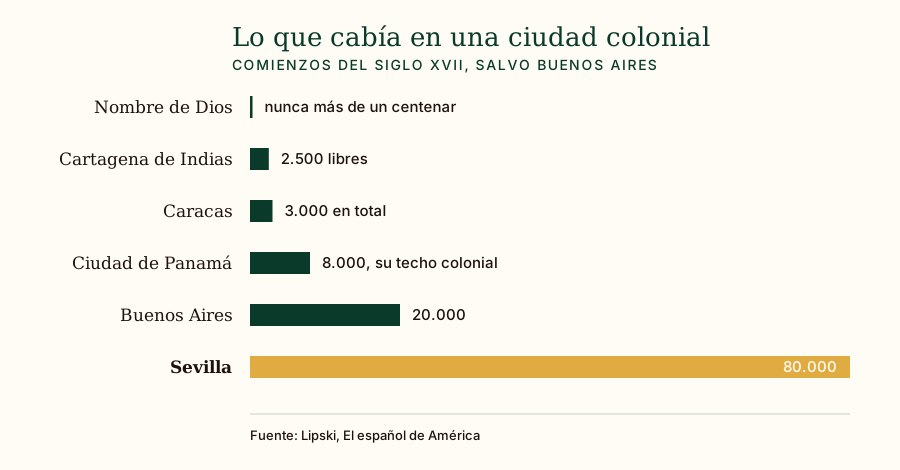
This is where the founding-mould theory cracks. Colonial cities were tiny, and putting them next to Seville is enough to show it.
At that scale the arithmetic does itself. A fleet arriving at Cartagena, Portobelo or Lima might carry several hundred settlers: in certain circumstances, a single fleet brought newcomers amounting to almost half the resident population. And even if not all of them stayed at the port of entry, their linguistic contribution still told.
If the decisive period were the Caribbean one, before 1530, we would be talking about a handful of island towns with a few thousand settlers in all. And across the whole sixteenth century, few cities in the Americas reached 5,000 inhabitants. Some of the places that now have national dialects of their own had not yet been founded.
The decisive argument
Half a dozen changes happened on both continents at once
The hardest argument to rebut is not demographic but chronological. Had American Spanish closed in on itself in 1530, it would not have continued to participate in later changes shared across the Atlantic.
In 1492 Castilian had six sibilant phonemes
In most present-day Latin American Spanish, those contrasts have been reduced to a single sibilant phoneme. The devoicing that preceded this reorganisation also developed in Spain, while the earliest loanwords from Nahuatl, Quechua and Guaraní show that settlers still preserved part of the medieval distinctions. The American system was not fixed by the first settlements.
The modern j formed in the mid-seventeenth century
And the harsher uvular Castilian version never arose in the Americas. It is not a simple transplant of Andalusian: it is a shared change that each side carried to a different point.
Usted did not exist in its modern form when Santo Domingo was founded
Neither usted nor ustedes had yet reached their modern form and distribution at the time of the first settlements. Their later spread on both sides of the Atlantic makes it difficult to argue that the American mould was already sealed.
B and v were still distinct
Nebrija in 1492 and Valdés in 1529 treat them as separate phonemes, and Spanish words that entered Indigenous languages during the sixteenth century reflect the difference. They merged later on both sides of the Atlantic.
What remains
The product of the whole population, not of the first settlers
No language that evolved in overseas colonies without being cut off from the metropolis keeps only the stamp of its first settlers. American English offers a useful parallel: the Great Plains shaped by generations of German and Scandinavian speakers, Chicago and Milwaukee by Polish, New York remodelled by Irish immigration. In every case, later arrivals also left their mark.
The same happened in the Americas. Antioquia took in many immigrants from northern Spain after the sixteenth century and retains a Castilian-style apical s. In the Dominican Republic, a large and permanent African presence helped to shape local speech. Canarian migration towards the Caribbean continued from the colonial period and had further waves in the nineteenth century. And Italian immigration to Buenos Aires and Montevideo, from the last decades of that century, marked the River Plate.
Founding heroes always take on more than life size when a country reconstructs its history. But with the language in front of you, the conclusion is different: Latin American Spanish is the product of the whole population, immigrant and Indigenous, and not only of those who arrived first.
Projects and corpora
Where the data behind the current picture lives
The argument continues, and today it rests on publicly accessible corpora that did not exist when it began:
Bibliography
The works consulted for this article
The Andalusian debate and the colonial population figures come from the relevant chapters of Lipski; the general framework from Aleza and Enguita. The last three are the works that discussion is built on, and to which both refer. All are in Spanish:
Lipski, John M. (2005 [1996])
El español de América. 4th ed. Madrid: Cátedra. On the regional origins of the settlers and on colonial demography.
Aleza Izquierdo, Milagros and Enguita Utrilla, José María, eds. (2010)
La lengua española en América: normas y usos actuales. Valencia: Universitat de València. Freely available online.
Boyd-Bowman, Peter (1956-1972)
A series of studies on the regional origin of the first forty thousand settlers, the basis of almost all later discussion.
Menéndez Pidal, Ramón (1962)
The fullest study of the linguistic contacts between Andalusia and the Spanish American coasts, and the origin of the distinction between the fleet area and the viceregal courts.
García Mouton, Pilar (2006)
«Los atlas lingüísticos y las variedades del español de América», Boletín Hispánico Helvético, 8, pp. 111-122.
Read next
The vos of El Cid and the vos of Mafalda
How a pronoun of maximum distance became the pronoun of maximum closeness.
Read the article