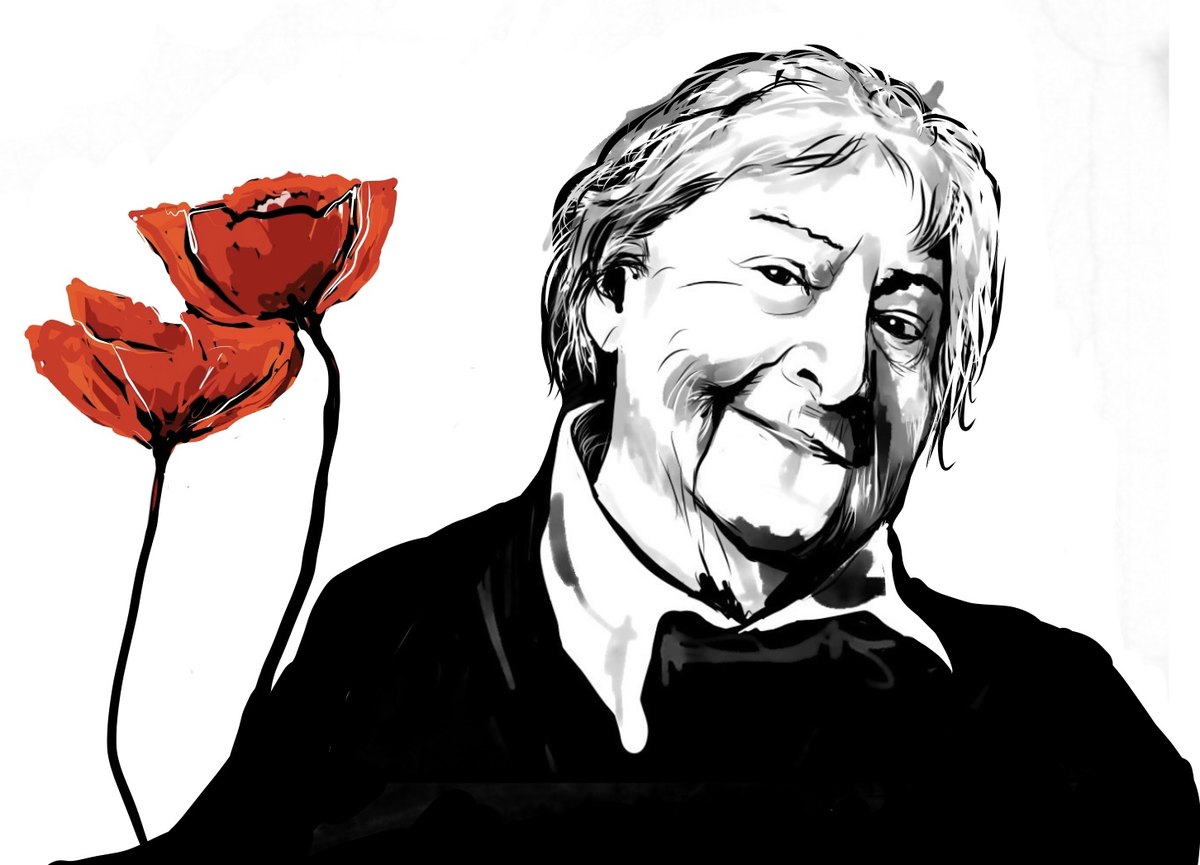
Ask a Spaniard in their forties who Gloria Fuertes was and they will most likely tell you about television, about a children’s programme and a woman with a smoker’s voice telling stories. That image, true as far as it goes, covers a far more uncomfortable biography. If you are learning Spanish in Madrid, she is worth knowing properly.
Who she was, in four facts
Born in Madrid in 1917 into a poor family, she wrote her first book at eighteen and waited fifteen years to publish it. She was the only woman close to the postista movement, founded a literary gathering because there was nowhere a woman could read her work aloud, and was among the very few included in the general anthologies of the 1960s. Television fame arrived late, and erased almost everything that came before.
Origins
An education designed to find her a job as fast as possible
She was born in Madrid in 1917 into a poor family. A girl’s education there had one clear purpose: to get her employed quickly. So she studied shorthand, typing, hygiene and childcare. Nothing to do with what she wanted.
She wrote Isla ignorada in 1935, at eighteen. It was not published until 1950. In between came twenty years of office work, from 1938 to 1958, supporting her family and herself, and alongside it, between 1939 and 1953, a job on the staff of the magazine Maravillas and children’s theatre.
In her own words
Nobody in my family ever told me to write
She put it without ornament: «When my mother saw me with a book, she hit me. Nobody in my family ever said to me, “write, my girl, write, you are good at it”. Nobody. I have nothing to thank my family for.»
Postismo
The only woman close to the group, and the one who kept its iconoclasm longest
In 1945 she became close to postismo, the movement of Chicharro, Carlos Edmundo de Ory and Sernesi: a post-war avant-garde built on humour and absurdity that connected back to the pre-war avant-garde. In the grey Madrid of those years, it was a way of standing your ground.
She was the only woman close to the group, and when postismo dissolved she was the one who kept that iconoclasm. It lasted her whole career.
In 1951, with Adelaida Las Santas, she founded a gathering whose name says everything: Versos con faldas, «verses in skirts». It existed for a very concrete and unromantic reason: there was nowhere a woman could read what she had written. So they organised it themselves.
The 1950s and 1960s
The books that gave her a reputation as a dissident
Across those two decades she published Antología y poemas del suburbio (1954), Aconsejo beber hilo (1954), …Que estás en la tierra (1962), Ni tiro, ni veneno, ni navaja (1965) and Poeta de guardia (1968). She was one of the very few women to enter the general anthologies of the period: in José Batlló’s of 1969, the only one.
Meanwhile she worked as a librarian at the International Institute, won a Fulbright in 1961 and taught at Bucknell, Mary Baldwin and Bryn Mawr. She had a relationship with the Institute’s American director, Phyllis Turnbull, until 1970. The break-up, and Turnbull’s death soon afterwards, left her seriously depressed.
Fame
A grant in 1972, then television, then the role of clown-poet
In 1972 she received the Juan March grant for children’s literature, threw herself into that register and ended up on Spanish national television. It made her hugely popular. It also erased everything that had come before.
She went from displaced poet to clown-poet. And, best of all, she liked the role. She was comfortable in it. She kept publishing: Sola en la sala (1973), Historia de Gloria (1980), Mujer de verso en pecho (1995).
The work
Four constants running through everything she wrote
Social criticism from the side of whoever is losing
Not one theme among others: it is the vantage point the whole body of work is written from.
Humour and wordplay
In a society as starched as Franco’s, these were straightforwardly subversive. A joke dismantles the language of power far better than a sermon does.
Irony at her own expense
The most effective way to deflate the solemnity of the literary establishment, and the reason she was taken less seriously than she deserved.
Tenderness
Which was not innocent in that context either.
Ethical values come before aesthetic ones in her work, and not as a shortcoming but as a programme. Her rejection of the models of womanhood imposed by the regime, together with the way she lived and wrote about sexuality, make her a reference point for the poetic feminism of the second half of the century. Not bad for someone remembered for a children’s programme.
Further reading
The references this profile rests on
These are the works behind this account. All are in Spanish:
Cano, José Luis (1991)
Vida y poesía de Gloria Fuertes. Madrid: Torremozas.
Payeras Grau, María (2003)
El linaje de Eva. Tres escritoras españolas de posguerra: Ángela Figuera, Celia Viñas, Gloria Fuertes. Madrid: SIAL.
Castro, Elena (2014)
Poesía lesbiana queer. Cuerpos y sujetos inadecuados. Barcelona: Icaria.
Jurado Morales, José (2014)
“El discurso patriarcal en la poesía femenina del primer franquismo”, Signa, 23.
Neira, Julio (2014)
“El canon y las mujeres del 27”, in La quimera de los sueños. Málaga: El Toro Celeste, 2nd ed., pp. 38-49.
Read next
Signing with another name in order to publish
Three different reasons not to sign your own name.
Read the article