Pen names appear in very different careers among twentieth-century Spanish women writers. They did not serve a single purpose: they could counter commercial prejudice, open a path into a male-dominated literary sphere or make it possible to work under political repression.
Three masks, three different jobs
A pen name is always a mask, but not all masks do the same work. There were at least three jobs here: dodging the reader’s prejudice, getting into a literary system that only admitted male voices, and surviving a regime that had erased you. What they share is how hard they are to reconstruct afterwards.
Carmen de Burgos
When the problem is that your own name does not sell
Carmen de Burgos (1867-1932) was Spain’s first professional woman journalist and its first woman war correspondent. She signed as Colombine, and published her column «Reading for women» in the Diario Universal under that name.
Colombine was not the only one. She also used Gabriel Luna, Perico el de los Palotes, Raquel, Honorine and Marianela. The reason says everything: her own name triggered prejudice. A piece signed Carmen de Burgos arrived pre-judged.
There is something else in her case, fascinating and a little sad. Alongside her feminist essays (Divorce in Spain, The modern woman and her rights) she published titles promising the secrets of the dressing table and the art of being loved, advertised with the promise of eternal youth. A contradiction? More like economics. Those books sold. The feminist essays, predictably, did not.
Lucía Sánchez Saornil
When the problem is gender, and the solution is to masculinise your own name
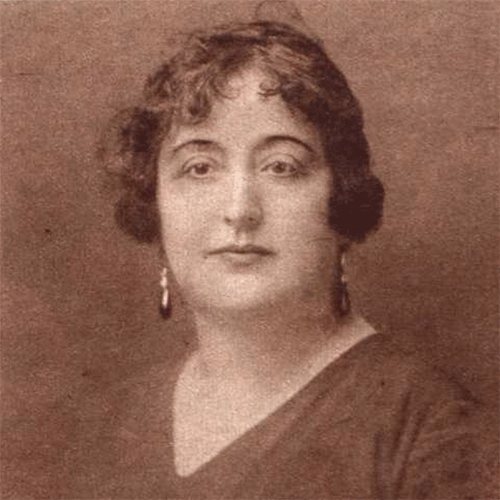
Lucía Sánchez Saornil (1895-1970) was the only woman to publish in the ultraísta magazines. From the start she attached her authorial identity to the pen name Luciano de San Saor.
Look closely at the operation: she does not invent an unrelated name, she masculinises her own. Lucía becomes Luciano; Sánchez Saornil becomes San Saor. It is her name, put through a filter that makes it publishable. Sometimes she used the real one, sometimes both at once, and that wavering says a good deal about how uncomfortable the situation was.
The intellectual climate
What could be written in 1923 without causing a scandal
In 1923 Ortega y Gasset (the most prestigious Spanish philosopher of the century) wrote quite calmly that lyric poetry requires «casting what is most intimate in us out into the universe» and that «these conditions occur only in the male», because woman is «natively concealing». That was what Lucía Sánchez Saornil was writing against.
Carmen Conde
When the obstacle stops being prejudice and becomes repression
After the Civil War, Carmen Conde was subjected to two summary proceedings, remained undocumented and had to confine herself for years in San Lorenzo de El Escorial. At times she concealed her name in order to work.
Magdalena Noguera
One of the heteronyms documented in her work.
Florentina del Mar
Used for short stories, children’s theatre, essays and translations.
Asunción Parreño
The third heteronym documented by studies of her activity during the post-war period.
The same woman who in 1979 became the first woman elected as a full member of the Real Academia Española had to alternate her own name with literary identities during the 1940s.
And as late as 1971, when Carmen Conde prepared her second anthology of women poets, she worked with Angelina Gatell, who could not sign it: she was under political sanction.
The consequence
Much of the recovery work has consisted of giving the names back
What the three cases share is how hard they are to reconstruct. Scattered names, works attributed to ghosts, authors who vanish from the handbooks because they are quite literally not signed where they should be.
When one of these writers is recovered today, half the research is not about interpreting the work. It is about proving whose work it is.
Further reading
Each of the three cases has its own monograph
The attributions given here come from the monographs devoted to each of the three. All are in Spanish:
Establier Pérez, Helena (2000)
Mujer y feminismo en la narrativa de Carmen de Burgos “Colombine”. Almería: Instituto de Estudios Almerienses.
Ferris, José Luis (2007)
Carmen Conde, vida, pasión y verso de una escritora olvidada. Barcelona: Temas de Hoy.
Gómez Garrido, Marta (2011)
La ambigüedad sexual en tres poetas de la modernidad: Lucía Sánchez Saornil, Ana María Martínez Sagi y Carmen Conde. MA dissertation supervised by María Dolores Romero López, Universidad Complutense de Madrid.
Neira, Julio (2020)
“El ultraísmo y la mujer”, in El ultraísmo español y la vanguardia internacional. Madrid: Instituto Cervantes.
Read next
Nine years and a photograph
From the Seville photograph, with no women in it, to the 1936 banquet.
Read the article