Two photographs tell this story better than any explanation. The first is from the Ateneo in Seville, December 1927, the founding event of the group: there is not a single woman in it. The second is from 19 April 1936, the banquet for the publication of Cernuda’s La realidad y el deseo. Nine years separate them.
What the second photograph shows
The whole front rank is there: Aleixandre, Lorca, Salinas, Alberti, Neruda, Bergamín, Altolaguirre. And also María Teresa León. And Concha Méndez seated at the head of the table, next to Cernuda. The press reported that Maruja Mallo, María Zambrano, Rosa Chacel, Concha Albornoz and several others were there too.
The starting point
Forty years with very few poetry books signed by women
To see how striking that change is, look at what came before. Between the death of Rosalía de Castro in 1885 and 1923, very few books of poetry by women were published in Spain. Pepa Merlo documents, among others, Gloria de la Prada’s Mis cantares (1911), Las cuerdas de mi guitarra (1913) and El barrio de la Macarena (1917); Casilda de Antón del Olmet’s Cancionero de mi tierra (1917); and Esther López Valencia’s Escorial (1922). Most were folkloric in character.
Those forty years spanned modernism, novecentismo and the avant-garde. They were decisive for contemporary Spanish poetry, while women had only a minimal presence in publishing.
The poetic reason
The Romantic idea of woman as muse was still alive: the object of the poem, never its subject.
The social and religious reason
Submission, chastity, modesty, confinement to the home. Where a poet was asked to pour his passions into verse, a woman was required to do exactly the opposite.
From 1923 onwards
The first books, and the imprint that placed them beside Lorca
From 1923 the books start to appear: María Teresa Roca de Togores, Pilar de Valderrama, Cristina de Arteaga, and in 1926 Concha Méndez with Inquietudes and Ernestina de Champourcin with En silencio.
In 1927 Josefina de la Torre published Versos y estampas, prefaced by Pedro Salinas, in the Litoral series, the same imprint that published Lorca, Alberti and Cernuda.
The two institutions
The Residencia de Señoritas, the Lyceum Club and «the revolt of the skirts»
Two institutions were decisive, and both came out of the spirit of the Institución Libre de Enseñanza.
The Residencia de Señoritas (1915)
The counterpart of the Residencia de Estudiantes, created to support university education for women.
The Lyceum Club Femenino (Madrid, 1926)
Where women organised for cultural activity, but also to run nurseries and help women without resources.
María de Maeztu directed both. The reaction was exactly what you would expect. María Teresa León recorded it: the matter reached the pulpits, political strings were pulled to put an end to «the revolt of the skirts», and when the club invited Jacinto Benavente to give a lecture he replied that he did not lecture «to silly women and madwomen».
Who they were
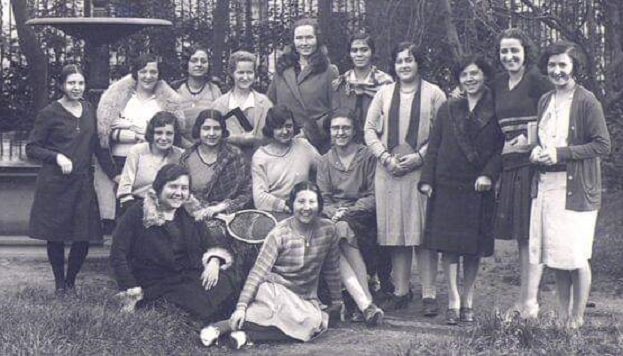
The group should not be idealised: nearly all of them came from the top
Nearly all of them came from the aristocracy or the upper middle class, because that was the only place a woman received the education that made writing possible. Cristina de Arteaga was the daughter of the Duke of Infantado. Ernestina de Champourcin was a baron’s daughter. Elisabeth Mulder inherited a Dutch marquisate and spoke six languages.
Writing was tolerated as a tasteful hobby. Doing it seriously was another matter: Concha Méndez fought her father for years and finally ran away from home at thirty.
A new model
Swimming and athletics champions, as well as writers
Introducing herself in Gerardo Diego’s anthology, Josefina de la Torre wrote: «I like to draw. I play tennis. I love driving my car, but my favourite sport is swimming». She had spent two years as president of the first swimming club in her home islands. She was not the only one: Concha Méndez was a swimming champion in San Sebastián in 1927, and Ana María Martínez Sagi a Spanish athletics champion as well as a journalist and writer.
The ceiling
Two names in Gerardo Diego’s anthology, and then the end of it all
And not only poetry: novelists such as Rosa Chacel, María Teresa León, Elena Fortún and Luisa Carnés; the philosopher María Zambrano; painters such as Maruja Mallo, Ángeles Santos and Remedios Varo. In politics, Clara Campoamor, Victoria Kent, Margarita Nelken and Federica Montseny, the first woman to serve as a government minister in Spain.
It lasted as long as it lasted. The Republic of 1931 brought women’s suffrage, divorce and wider access to education; national Catholicism reversed much of that progress and reimposed a model of female subordination.
And one figure sums up the other side of the story: Gerardo Diego’s first anthology of contemporary Spanish poetry (1932) contained no women at all. In the expanded second edition he included two: Ernestina de Champourcin and Josefina de la Torre. Two. That was the ceiling, even at the best moment.
Further reading
Four books that reconstruct the whole period
The account of these nine years rests on these four works. All are in Spanish:
Mangini, Shirley (2001)
Las modernas de Madrid. Las grandes intelectuales españolas de la vanguardia. Barcelona: Península.
Valender, James, ed. (2001)
Una mujer moderna. Concha Méndez en su mundo (1898-1986). Madrid: Residencia de Estudiantes.
Ulacia Altolaguirre, Paloma (2018)
Concha Méndez. Memorias habladas, memorias armadas. Sevilla: Renacimiento.
Neira, Julio (2014)
“El canon y las mujeres del 27”, in La quimera de los sueños. Málaga: El Toro Celeste, 2nd ed., pp. 38-49.
Read next
Gloria Fuertes, the poet Spain thought it knew
Behind the television presenter, a postista poet and a dissident voice.
Read the article